Our Work: The Shape of the Engagements
The kinds of governance and executive engagement Banff Executive Leadership ran, the sectors it worked in, and how a senior engagement actually proceeded.
Banff Executive Leadership worked across several sectors on board governance and executive engagements, from the first conversation through follow-through.
The practice said that its strategic solution-building experience had been built up through senior leadership positions in management education, the private sector and the practice itself. That sequence matters. The work described below was designed by people who had held the accountability, not only advised on it.
Kinds of engagement
- Board retreats and planning sessions. A board taken off site, usually for two or three days, working on its own mandate, its strategic direction, or a decision it had been circling for a year without resolving.
- Governance policy and by-law work. The unglamorous end of the board governance practice, and often the most consequential: developing improved governance processes and by-laws, and building a shared understanding of the work of governance as distinct from operational work.
- Board effectiveness evaluation. Structured assessment of how a board was actually functioning, which is the point at which most boards discover that the model they believe they operate is not the model they operate. The framework behind it is set out under board governance.
- Executive team strategy sessions. Facilitated strategic processes and decision-making with an executive team, on site or in a strategic retreat, aimed at strategy formation and at the people-mobilization work that determines whether a strategy survives contact with the organization.
- Coaching. Short-burst engagements with executive team members, held to an extended commitment of improvement rather than a single session, and coaching guidance for board chairs and individual board members. See the coaching record.
- Keynote sessions. Conference and association addresses, usually built from the same research as the programmes rather than written for the occasion.
- Custom in-house programmes. Programmes designed for one organization's board or executive group, alongside the public offerings listed under programmes.
Sectors
Described generically, the work spanned national carriers and transportation; banking, trust and financial services; energy, petroleum and mining; national and provincial health authorities, boards and councils; education; municipal, provincial and territorial government, including a northern territory administration; federal departments and agencies; professional associations; pension boards; workers' compensation bodies; national charities and not-for-profits; media and broadcasting; agriculture; Indigenous communities and councils; and government ministries in South-East Asia and in Eastern Europe and the Russian Federation. The international work is worth flagging, because the questions it raised are visible in the published articles: governance frameworks developed in one legal and cultural setting travel considerably less well than the people exporting them tend to assume.
How a senior engagement ran
The pattern was consistent enough to describe. It began with a scoping conversation, normally with the board chair or the chief executive rather than with a training function, and normally about a presenting problem that was not the real one. A board asking for a session on strategic planning frequently turned out to have a role-clarity problem between itself and management, which is a board governance question rather than a planning one; a chief executive asking for team-building frequently had a decision-rights problem. Establishing which was which was the first piece of work, and the practice was willing to say that the engagement being requested was not the engagement required.
Design followed, and it was custom rather than catalogue. Programmes were built on competency-based research and active learning approaches, on an explicit commitment that participants would leave with tools, models and insight they could apply to their own circumstances immediately. Where a specialist was needed, a faculty associate was matched to the engagement rather than drawn from a rota; the associate network existed for exactly this step.
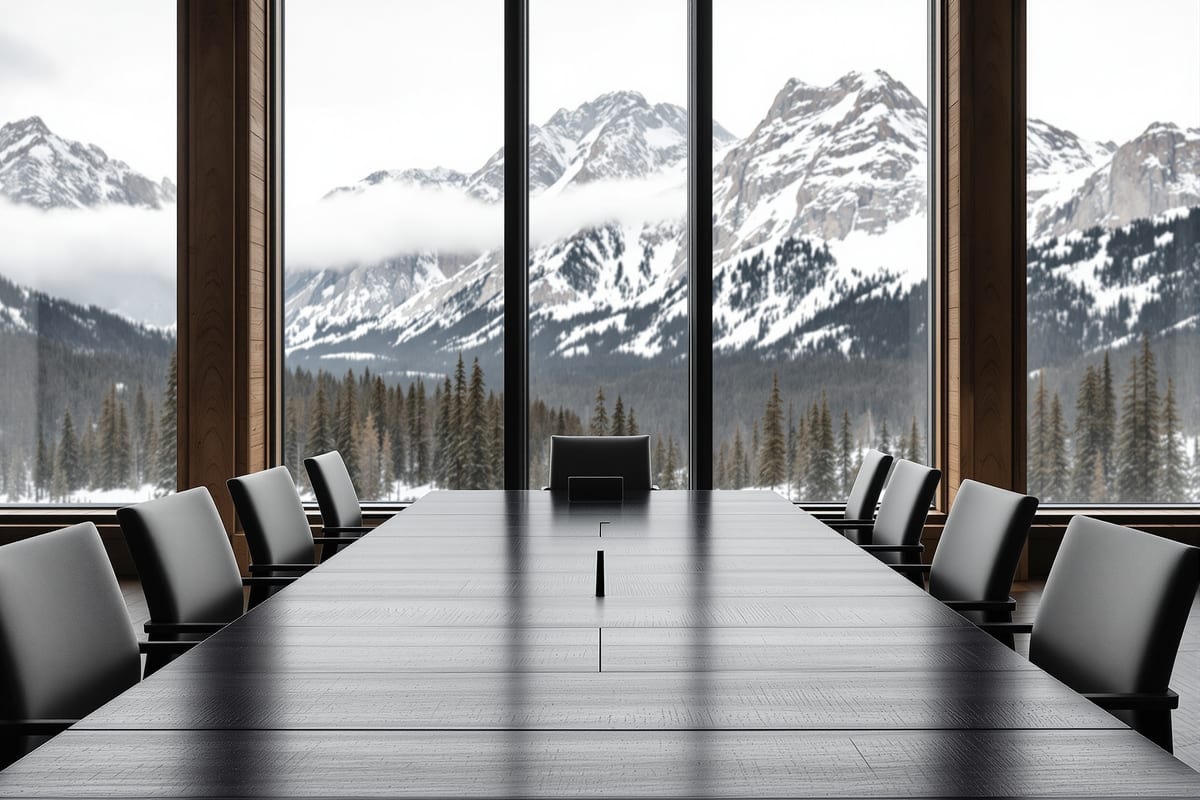
Delivery was usually residential and usually off site, in small cohorts of uniformly senior people. That is a deliberate design decision rather than a hospitality one. A group of directors carrying comparable accountability will say things to each other that none of them would say in their own boardroom, and a great deal of the value came from that rather than from the front of the room. The mountain setting was worked into the sessions rather than admired through the window.
Follow-through was the part most easily skipped and most often insisted upon: revised by-laws or terms of reference actually drafted, an effectiveness review with a date attached to the next one, a coaching commitment extending past the retreat. The practice's own stated measure was the ability to transform organizations through individual leadership competency and through the processes that support transformation, which is not a claim a two-day session can satisfy on its own.
None of this is on offer. The shape of the work explains the writing.
The obligations that shaped this kind of work are set out today in the G20/OECD Principles of Corporate Governance and, for Canadian corporations specifically, in the guidance published by Corporations Canada.